Editor's Introduction
Abstract
We have been discussing for a long time how the editorial board's appeal should be structured. This format, as a rule, has a clear structure: to explain who we are, why we came and what new things we bring; what will be in the world from us and what will change in the world. It doesn't seem to be anything complicated. Nevertheless, for a long time we felt at a dead end: the answers to these questions require strict formalization, while we saw the reason for the need to create a cool magazine project, otherwise it would simply expand the space of possible meanings, where the only censorship, grid, prison can only be the "transparent prison of language", but even here The key word is "maybe." If we connect philosophical reflection, the usual philosophical procedure, it will probably turn out – it turned out right now – that everything should be said-nothing, just about who we really truly are. Eg: "We are a team of young philosophers...". Indeed, we are a team of young philosophers. We are young enough to believe that philosophy can change the world, and also to believe in knowledge that can "break the chains of slavery." But we are also mature enough to give this time and to understand the need for time, which does not necessarily imply a path of reform, but rather a path of solution. Actually, we are making this "decision" now. So, both of these impulses (thoughts about change and time) probably gave rise to the project that we named ironically and, hopefully, modestly: another one. So what does it mean? To be extremely serious, then a break and at the same time a spike with tradition (by which we will mean heritage): it's just another philosophical journal, another thought and another interpretation, etc... an endless field of possibilities. But also another one—just another one. Therefore, to be extremely honest, this is an unwillingness to always be extremely serious. Let's leave this to the content of our releases; we would like the community to generate not only seriousness, but also joy.
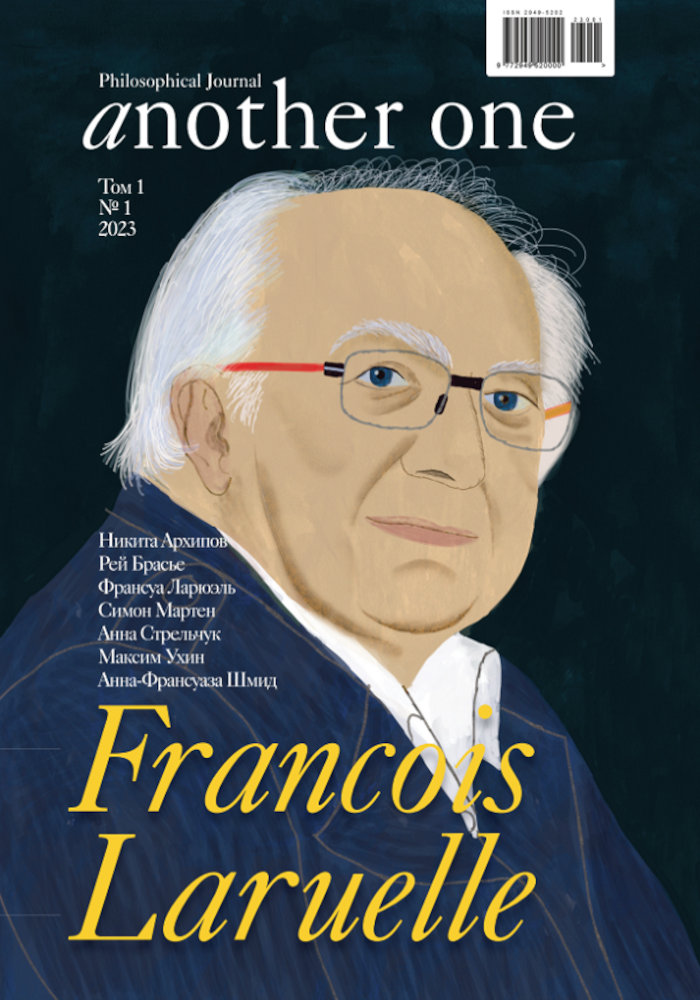
The first issue of another one is dedicated to Francois Laruel, who… it was a spontaneous decision based on nothing but shameless boldness in choosing a stranger and — returning from extreme honesty to extreme seriousness — simply the fact that there is a certain philosopher n, a colleague, sometimes an associate of famous n to the degree of n (Deleuze, Nancy, Dufresne, Lyotard and Co.), the creator of a certain non-philosophies and theories are participants in the intellectual debates of the second half of the twentieth century, today. But if "What is philosophy?" Deleuze and Guattari are already classics of immanentist thought (in Russia in particular), but Laruel is not familiar to the Russian reader. So we understood: it's time to introduce.
The latest translation of Francois Laruel's texts with an extensive body of commentary was published with the financial support of the French Institute in the Blue Sofa magazine in 2013. This publication was the first serious reason for discussion about Francois Laruel in the Russian academic environment. Nevertheless, Laruel's texts, which are key to understanding non-philosophy, have not yet been translated into Russian. And we are happy to inform you that the situation has changed: here is a whole issue with translations of key texts, as well as a block of articles (original, published for the first time, as well as translated ones) about Laruel and non-philosophy.
Finally, our (shared) journey into non-philosophy would not have taken place if it hadn't been for: Artem Morozov and Nikita Arkhipov, who advised us on all issues related to French philosophy, French and philosophy and vise versa, Anna-Francoise Schmid and Simon Martin, Anna Strelchuk and Mikhail Lyaskovsky, Rodion Kitaev and Artyom M., Tatiana Pavlova, Marina Strepetova, Dmitry Zhukov, Ray Brasier, Alexander Pisarev. The editors would also like to thank the French Institute, an organization that has helped to publish and continue to publish a large number of radically important texts in Russia, and thanks to whose support non—philosophy has gained a material basis.
Keywords
философия, Франсуа Ларюэль
Author Biography
Lolita Agamalova
Postgraduate Student, Department of Ontology and Theory of Knowledge, Faculty of Philosophy, Lomonosov Moscow State University; 1 Leninskie Gory, Moscow, 119991, Russian Federation. Editor of the Another One Journal.
Nikolay Kshevin
Postgraduate Student, Department of Ontology and Theory of Knowledge, Faculty of Philosophy, Lomonosov Moscow State University; 1 Leninskie Gory, Moscow, 119991, Russian Federation. Editor of the Another One Journal.
Mariia Romanyuk
Postgraduate Student, Department of Philosophy and Methodology of Science, Faculty of Philosophy, Lomonosov Moscow State University; 1 Leninskie Gory, Moscow, 119991, Russian Federation. Editor of the Another One Journal.
Maxim Ukhin
Postgraduate Student, Department of Ontology and Theory of Knowledge, Faculty of Philosophy, Lomonosov Moscow State University; Lecturer, Institute of Business and Design. 119991, Russian Federation, Moscow, Lomonosov Moscow State University, Leninskie Gory, 1. Editor of the Another One Journal.